
Environment
Climate Change Response
- Governance: The Board oversees climate issues, receiving at least annual reports from the ESG Working Group, led by the General Manager and department heads under Board oversight.
- Strategy: Using 2025 as the baseline year, ASIX commits to reducing Scope 1 and 2 emissions by 5% by 2030 and achieving net zero by 2050, focusing on low‑carbon design, supply chain collaboration, renewable energy, and 3R principles.
- Risk Management: Climate risks—including physical risks (extreme weather) and transition risks (regulatory changes, supply chain carbon costs)—are integrated into the enterprise risk framework.
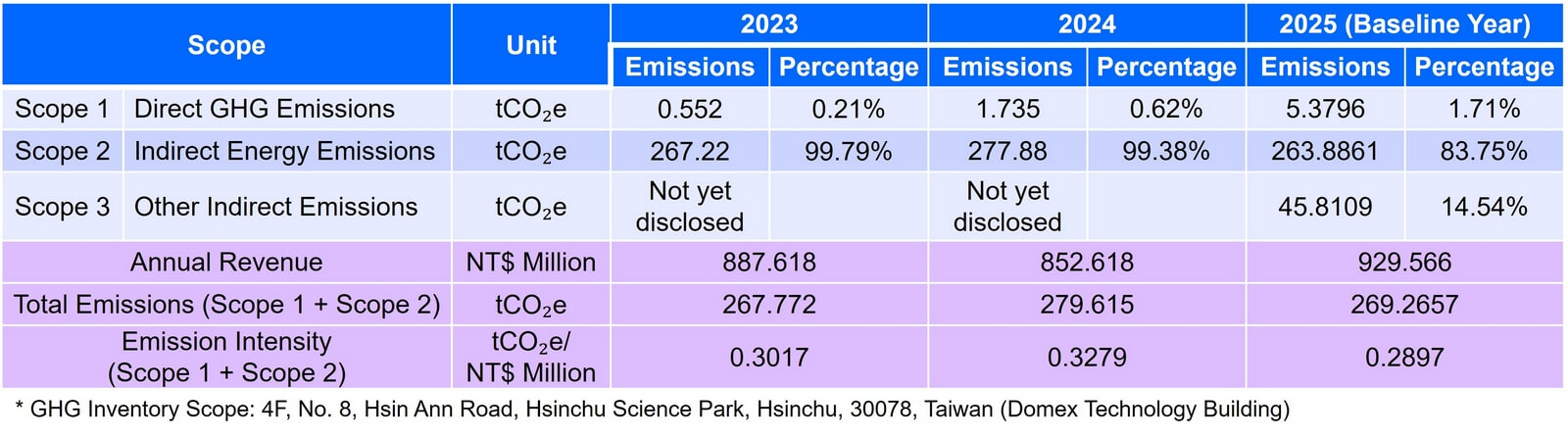
- Metrics & Targets: Current indicators are Scope 1 and 2 emissions (269.2657 tons CO₂e in 2025, intensity 0.2897 tons CO₂e per NT$ million). Targets: 5% reduction by 2030, net zero by 2050.
GHG and Energy Management
Greenhouse Gas Management Policy
Energy conservation and carbon reduction are essential not only for enhancing global competitiveness but also for reducing greenhouse gas emissions. At ASIX, electricity consumption is primarily driven by air‑conditioning systems, which have faced increasing loads due to rising temperatures from climate change. Despite this challenge, the company continues to implement energy‑saving measures and improve efficiency to minimize environmental impact. A comfortable office environment, combined with employee awareness and practices such as switching off unused equipment, further supports resource conservation.
GHG Inventory Results
Since 2025, ASIX has conducted annual greenhouse gas inventories under ISO 14064‑1:2018, verified by third parties to ensure transparency and credibility. The 2025 results show Scope 2 emissions accounted for 83.75% of total emissions, followed by Scope 3 at 14.54% and Scope 1 at 1.71%. Combined Scope 1 and 2 emission intensity was 0.2897 tons CO₂e per NT$ million.
Scope 3 GHG Inventory Results
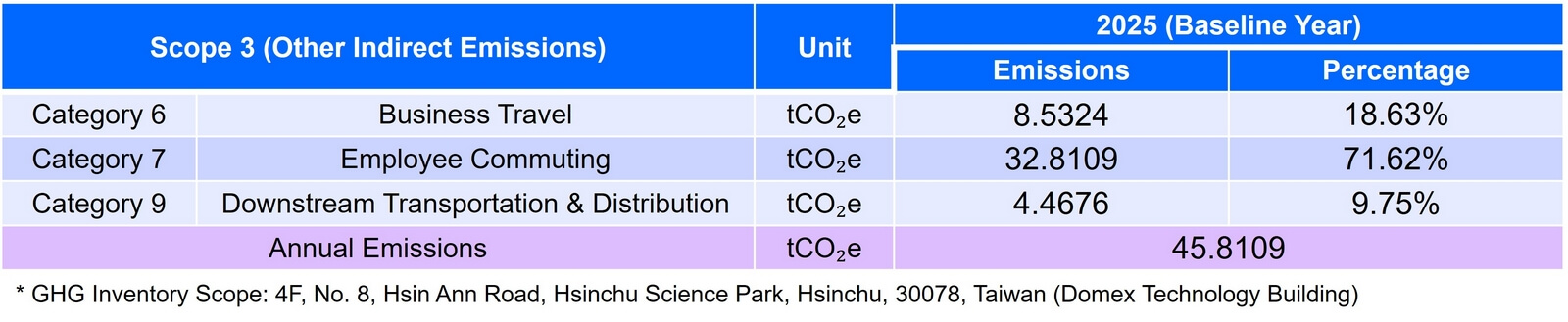
The company has set 2025 as the baseline year for its first Scope 3 inventory under the GHG Protocol. Categories 6 (business travel), 7 (employee commuting), and 9 (downstream transportation & distribution) were identified as the main emission sources, while other categories were deemed non‑material due to the company’s fabless nature without manufacturing facilities. These categories were therefore excluded from the 2025 inventory, but future changes in business operations may expand the scope.
Following the GHG Protocol, the company completed the 2025 Scope 3 greenhouse gas inventory and disclosed emissions by category as summarized below.
Energy Management Policy
ASIX is a professional IC design company whose primary energy consumption comes from purchased electricity. The company does not operate coal, gas, or boiler facilities, nor does it maintain energy‑intensive processes, corporate vehicles, or emergency generators. ASIX has obtained ISO 14001 environmental management certification and promotes systematic energy management and continuous improvement. Major electricity use includes air conditioning, lighting, and IT equipment. Through energy‑saving campaigns and equipment maintenance, the company minimizes unnecessary consumption. Going forward, ASIX will continue to track energy usage trends and implement conservation measures to reduce consumption and align with global sustainability goals.
Energy Conservation and Carbon Reduction Measures
- Prioritize energy‑efficient products in procurement and replacement.
- Implement high‑efficiency chillers for air‑conditioning systems.
- Replace all lighting with LED fixtures.
- Use energy‑saving IT and network equipment.
- Apply high‑efficiency UPS systems to reduce power use.
- Continuously adopt new energy‑saving technologies.
Energy Management Plan and Implementation
ASIX , a fabless IC design company, relies primarily on purchased electricity for its operations. The company has established an energy management plan, setting 2025 as the baseline year and a mid‑term target to reduce per‑capita energy consumption by 5% by 2030.
To achieve this goal, ASIX has implemented specific measures, including:
- Full replacement of office lighting with LED fixtures
- Transition of employee computers to low‑power laptops
- Prioritization of high‑efficiency equipment in procurement
- Regular employee training on energy conservation
2025 Achievements: LED lighting and computer replacement projects saved approximately 25,227 kWh, equivalent to a reduction of 12.5 tCO₂e.
Energy Use in Recent Years:
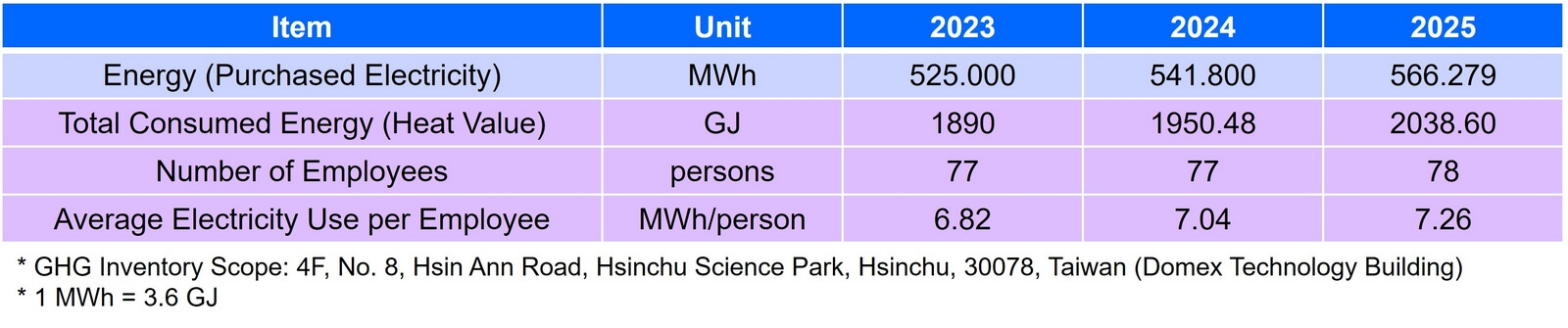
- 2024: Total energy consumption 1950.48 GJ (541.8 MWh purchased electricity), renewable energy share 0%
- 2025: Total energy consumption 2038.60 GJ (566.279 MWh purchased electricity), renewable energy share 0%
Electricity Inventory Results
According to the latest electricity inventory, ASIX’s primary energy source is purchased electricity, with no renewable energy currently in use. In 2025, electricity consumption totaled 566.279 MWh, equivalent to 2038.60 GJ. Average electricity use per employee was 7.26 MWh.
Lighting Efficiency Driving Net‑Zero Goals
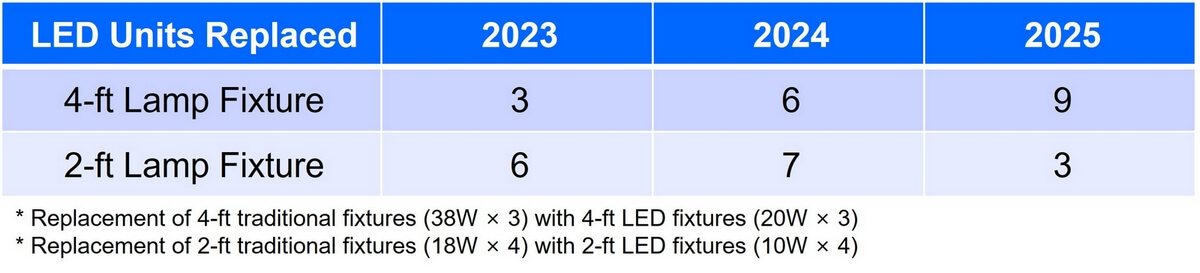
To enhance energy efficiency and support low‑carbon operations, ASIX replaced traditional office lighting with LED fixtures in 2025. This upgrade reduced electricity demand by approximately 582 watts, delivering an annual carbon reduction of about 714 kg CO₂e. The savings are equivalent to avoiding emissions from driving over 3,570 km or the annual carbon absorption of roughly 60 trees. Through this initiative, ASIX demonstrates its commitment to energy conservation and continues to optimize electricity use, advancing steadily toward net‑zero and sustainable development goals.
2025 Employee Computer Upgrade for Energy Conservation

In 2025, ASIX invested NT$1 million to replace 29 employee desktop computers (450W each) with low‑power laptops (56W each), reducing power demand by 394W per unit. Assuming 2,000 operating hours annually, each new device saves approximately 788 kWh, for a total annual saving of 22,852 kWh. This corresponds to a reduction of 11.3 metric tons of CO₂e.
This initiative effectively lowered office electricity use and carbon emissions, improved energy efficiency, and demonstrated ASIX’s commitment to energy conservation, green transition, and sustainable development. The company will continue monitoring energy trends and implementing further conservation measures to support global carbon‑reduction goals.
Low‑Power Green Product Design Achievements
ASIX continues to integrate energy‑saving and carbon‑reduction concepts into product development, applying green design to lower energy consumption and enhance performance. In the development of new‑generation chips, low‑power design and high‑efficiency architectures are adopted as concrete actions to fulfill sustainability commitments.
For example, the AX88279A USB 3.2 Gen1 to 2.5G Ethernet controller, released in 2025, consumes only 698.6 mW compared to 1,553.8 mW for the previous AX88279 model — a reduction of about 55%. This design not only improves performance but also significantly reduces energy use and carbon emissions.
Based on estimates, if a single chip operates 5,000 hours annually, each new device saves about 4.28 kWh, equivalent to 2.12 kg CO₂ per year. With shipments of 1 million units, total annual carbon reduction reaches approximately 2,120 metric tons CO₂, equal to the carbon absorption of 5,500 trees in one year.
Beyond product innovation, ASIX also promotes green supply chain management, requiring partners to follow energy‑saving and carbon‑reduction principles. Through digitalized carbon management, the company ensures sustainability across the entire product lifecycle. Looking ahead, ASIX will continue strengthening low‑carbon innovation and green design, verified by international standards and transparent disclosure, contributing to global net‑zero goals.
Water and Waste Management
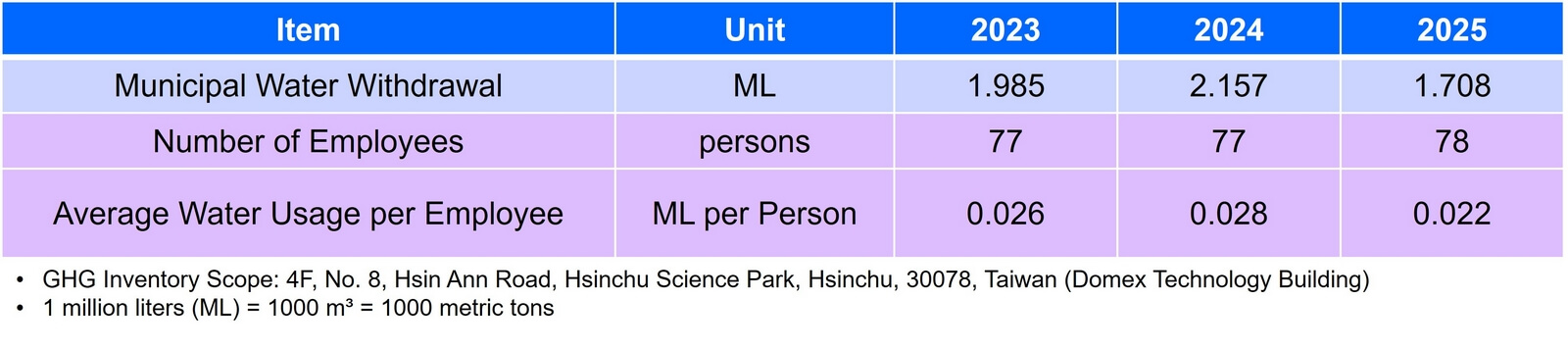
Water Resource Management Policy
- Raise employee awareness and promote responsible water use.
- Use certified water‑saving toilets, faucets, and fixtures.
- Adjust supply flow and install conservation valves.
- Apply chemical treatment in cooling towers to reduce water use.
- Implement real‑time reporting to fix leaks quickly.
Waste Management and Circular Economy
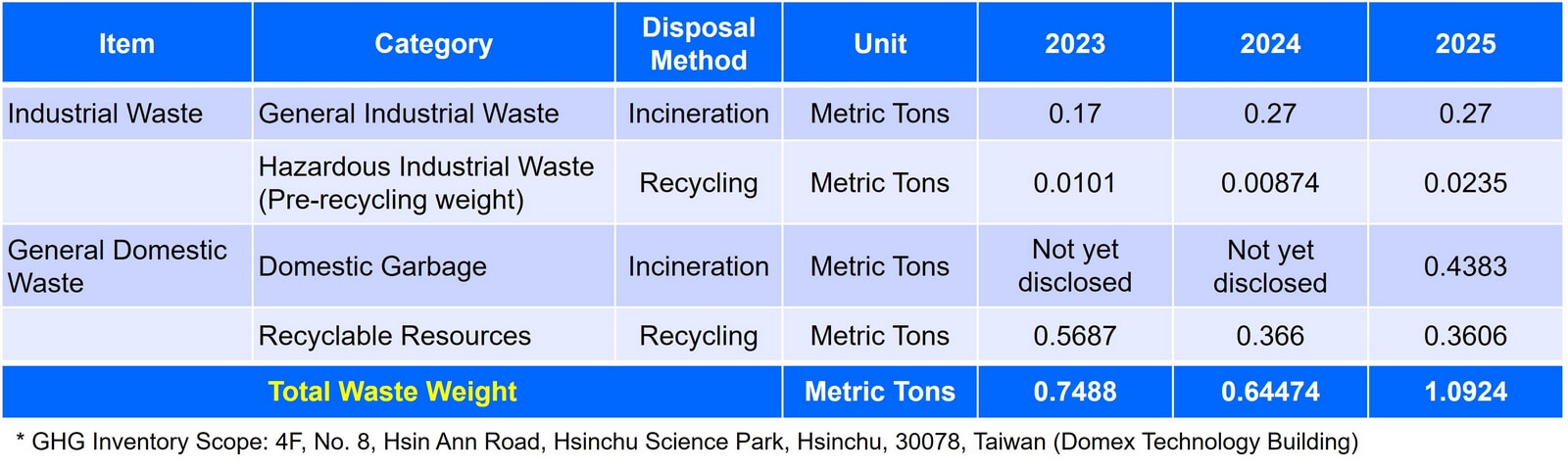
ASIX Electronics, a semiconductor IC design company, primarily generates general office and business waste (such as paper, food waste, and daily garbage) and hazardous waste (including discarded electronic components, circuit boards, and scrapped ICs) from office operations and R&D testing samples. General waste is managed by qualified contractors, while hazardous waste is handled by licensed third‑party vendors approved by the government, with compliance audits conducted regularly. No violations or illegal dumping were identified in 2025.
The company promotes waste segregation, employee awareness, and reduction initiatives, and has established a circular economy policy focused on “reducing resource consumption and enhancing resource recycling.” Key actions include green procurement, paper reduction, and waste sorting for recycling.
ASIX has adopted a waste‑reduction management policy using 2025 as the baseline year, with a mid‑term target of reducing office waste by 5% by 2030.
Implementation Results
- In 2025, paper usage decreased by 57,208 sheets compared to 2018 levels (−71.4%), achieving a carbon reduction of approximately 330 kg CO₂e.
- Waste inventory: 0.64474 metric tons in 2024 (excluding domestic waste) → 1.0924 metric tons in 2025 (including domestic waste data).
Waste Inventory Results
Based on the latest annual waste inventory, ASIX’s waste primarily comprises general domestic and business waste (paper, food waste, daily garbage) and hazardous waste (discarded electronic components, circuit boards, and scrapped ICs). In 2025, the company’s total waste reached 1.0924 metric tons, of which general business waste represented 24.72%, hazardous waste 2.15%, domestic garbage 40.12%, and recyclable resources 33.01%. The increase compared with 2024 was mainly due to a comprehensive laboratory waste clean‑up conducted in 2025.
Paperless Office – Carbon Reduction Results
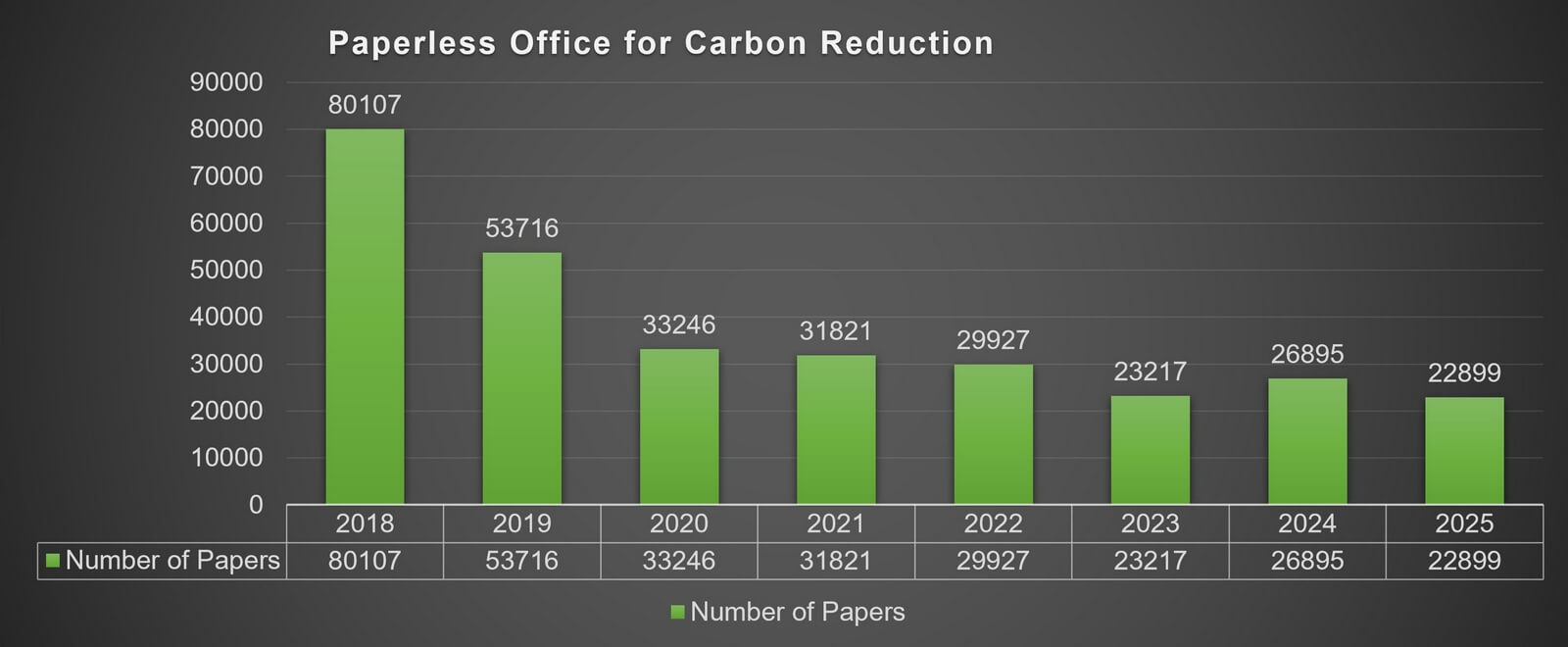
Since February 2019, the company has actively advanced paperless office initiatives to promote digital management and achieve carbon‑reduction goals. Measures include developing an electronic signature platform and encouraging employees to replace paper documents with electronic files. Compared with pre‑implementation levels in 2018, the company reduced 57,208 sheets of copy paper in 2025, achieving an estimated carbon‑reduction benefit of 330 kg CO₂e. This reduction is equivalent to avoiding emissions from driving a car for more than 1,650 kilometers, or the annual carbon absorption of 28 trees. These results clearly demonstrate the company’s commitment to low‑carbon transition and sustainable development in daily operations.